
St Paul’s Square in The Jewellery Quarter Birmingham
When exploring the Jewellery Quarter in Birmingham, most visitors find themselves drawn to the serene elegance of St Paul’s Square before they even realise their arrival at the historic heart of the district. This is not a shopping centre or a pedestrianised precinct. It is a proper Georgian square, the last of its kind in Birmingham, and it anchors an entire neighbourhood devoted to the craft of fine jewellery. The Quarter produces 40 per cent of all jewellery made in the UK, yet it wears that statistic lightly. Walk through on a weekday morning and you will hear the quiet hum of workshops, and understand that this is a place where things are still made by hand. Whether you are here to commission an engagement ring, trace the footsteps of industrial pioneers, or simply enjoy a long lunch in a converted factory, the Quarter rewards curiosity. This guide covers everything you need to plan a visit to the place with so much potential to inspire, from the history of St Paul’s Square to where to park, eat, and find the right jeweller for your needs.
The Extensive History of St Paul’s Square and the Jewellery Quarter
St Paul’s Square was laid out between 1777 and 1779 on the edge of what was then a rapidly expanding Birmingham. It was conceived as a genteel residential enclave for the city’s merchant class, a place where wealthy families could enjoy tree-lined views and a sense of remove from the smoke and clamour of the workshops below. The square took its name from St Paul’s Church, a handsome brick building consecrated in 1779, which still stands at its centre and remains an active place of worship and community gathering. For a brief period, this was a fashionable address, its tall sash windows and wrought-iron balconies signalling prosperity and taste.
The architectural significance of the square extends well beyond the church. Many of the surrounding buildings hold Grade II listed status, preserving the original 18th-century street pattern and scale. Walking the perimeter, you can still trace the restrained elegance that would have greeted the square’s first residents: doctors, merchants, and manufacturers who wanted proximity to the city without sacrificing genteel calm.
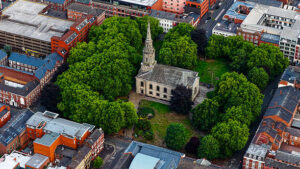
The character of the area changed decisively with the opening of the Birmingham and Fazeley Canal in 1789. The canal sliced through the landscape and connected Birmingham to the national waterway network, making the transport of raw materials and finished goods cheaper and faster than ever before. Industry followed the water. Workshops, foundries, and plating factories sprang up on plots that had previously been gardens. Wealthy residents decamped to leafier suburbs, and their elegant townhouses were subdivided into workshops and lodgings for the artisans who flooded in. By the middle of the nineteenth century, the square and the streets radiating from it had become the epicentre of Britain’s jewellery trade.
Two names dominate this period. George Elkington established his electro-plating works in the Quarter in the 1840s, perfecting a process that allowed a thin layer of silver or gold to be applied to base metal. His innovation democratised fine-looking tableware and jewellery, and his factory employed a young chemist named Alexander Parkes, who would go on to invent the world’s first plastic. Meanwhile, the Birmingham Assay Office was founded in 1773 and later moved into purpose-built premises in the Quarter. Today it is the largest assay office on the planet, hallmarking around 12 million items each year. Its presence is not ceremonial; it is a working institution that tests and stamps precious metals to this day, and its anchor mark is a guarantee of quality recognised worldwide.
The twentieth century brought decline and then renewal. Heavy manufacturing contracted, and many of the Quarter’s buildings fell into disrepair. From the 1980s onward, a concerted conservation effort preserved the area’s architectural fabric and attracted a new wave of independent jewellers, designers, and creative businesses. The Quarter is now a mixed-use conservation area where listed Georgian facades sit alongside contemporary apartments, galleries, and some of the best restaurants in the Midlands.
St Paul’s Church: The Heart of the Square
St Paul’s Church dominates the square physically and spiritually. Designed by Roger Eykyn of Wolverhampton, construction began in 1777 and the church was consecrated in 1779. Its spire, a later addition by Francis Goodwin in 1823, gives the building its distinctive silhouette against the Birmingham sky. The church holds a Grade I listing, the highest level of protection, placing it among the most significant buildings in the country.
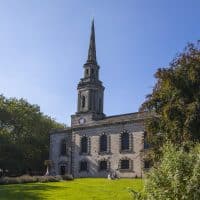
Inside, the east window commands attention. Installed in 1791, this stained-glass masterpiece was designed by Benjamin West, an American-born artist who would later become president of the Royal Academy, and executed by Francis Eginton, a Birmingham-based glass painter of considerable reputation. The window depicts the Conversion of St Paul, a subject that gives the church its name and its narrative anchor. It is a rare survival, both artistically and historically, and worth the visit alone.
Beyond its architectural and artistic merits, the church functions as a living space. Described by many as an “oasis of tranquillity,” it offers a quiet retreat for reflection and worship, a stark contrast to the commercial energy of the surrounding Jewellery Quarter. The church also hosts concerts, exhibitions, and private events throughout the year, making it an active cultural hub rather than a static monument. Checking the parish’s “What’s On” programme before your visit is wise; you might find a lunchtime recital or a seasonal service that adds depth to your experience.
Things to Do in St Paul’s Square
Dine at Saint Paul’s Market (The Food Hall)
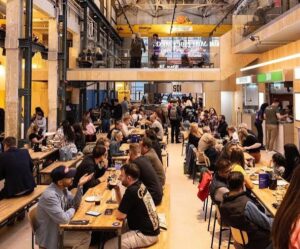
Saint Paul’s Market has quickly established itself as one of Birmingham’s most compelling food destinations. Housed in a sensitively converted building on the square, the market brings together seven independent kitchens under one roof, offering a culinary tour that spans continents without leaving your seat. The lineup includes Chancer’s for fried chicken, Corner Shop Pizza for Detroit-style slices, Colbeh for Persian dishes, Zindiya for Indian street food, Soi for BBQ Thai, Tiger Bites Pig for bao, and LA-POP for gelato popsicles. The variety is the point: a group with conflicting cravings can all eat well without compromise.
The space seats approximately 500 diners, so even at peak times the atmosphere stays lively rather than chaotic. Long communal tables encourage a casual, social style of eating, though there are quieter corners for couples and solo visitors. The market is dog-friendly, welcoming well-behaved dogs on leads, which makes it a practical stop for pet owners exploring the Jewellery Quarter. Booking a table in advance is recommended for weekend evenings, when the market draws a substantial crowd from across the city.
Stay at Saint Paul’s House (Boutique Hotel)
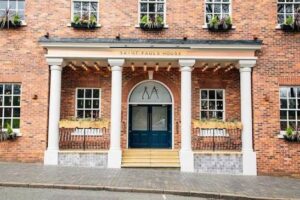
If the market is the square’s beating heart by day, Saint Paul’s House is its sophisticated pulse by night. This boutique hotel offers 34 individually designed rooms that balance modern comfort with the building’s Georgian character. Expect exposed brickwork, rainfall showers, and a design sensibility that feels contemporary without erasing the past. It is the kind of place that suits a weekend break, a wedding night, or a business stay that does not feel like a compromise.
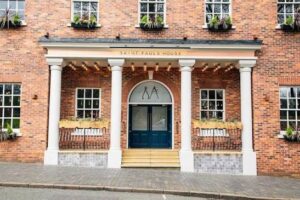
The hotel’s ground-floor restaurant and bar serve seasonal British fare with a confident, unfussy approach. The real draw, however, is the terrace, which can host up to 60 guests for weddings and private parties. On a warm evening, with the church spire rising beyond the fairy lights, it is one of the most atmospheric spots in the Jewellery Quarter. Location-wise, the hotel sits steps from St Paul’s tram stop and a short walk from Birmingham city centre, making it a convenient base for wider exploration.
Explore the Royal Birmingham Society of Artists (RBSA)
Tucked just off the square, the Royal Birmingham Society of Artists runs a gallery that punches well above its weight. The RBSA showcases contemporary work from regional artists through a rotating exhibition programme that spans painting, printmaking, sculpture, and mixed media. Entry is free, which makes it an easy addition to any visit. The gallery offers a quiet counterpoint to the square’s food and drink offerings, a space where you can slow down and engage with Birmingham’s living creative scene rather than only its historical one.
Visit St Paul’s Club (Private Members’ Club)
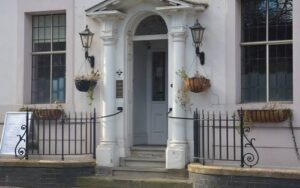
St Paul’s Club occupies a distinctive niche in Birmingham’s social history. Founded in 1859, it is the Midlands’ oldest private members’ club, a survivor from an era when such establishments were central to business and political life. The club is primarily for members, but it does occasionally open its doors for public events or private hire. If you are planning a visit around a specific date, it is worth enquiring ahead about access. For heritage enthusiasts, the club represents a living thread connecting the square’s Georgian origins to its Victorian and modern identities.
Photography and Architecture Walk
The square rewards those who take their time. The Georgian terraces, cobbled streets, and the church spire create a compact but richly layered subject for photographers. A self-guided walk can take in the Grade II listed buildings, the church exterior, and the surrounding jewellery workshops that remind you this is still a working quarter. Early morning light catches the brickwork beautifully, while late afternoon softens the scene for portraits and detail shots.
Practical Visitor Information for St Paul’s Square
Getting to St Paul’s Square is straightforward. The square is served by St Paul’s tram stop on the Midland Metro line, with regular services running from Birmingham city centre and Snow Hill station. Several bus routes also pass through the Jewellery Quarter, and for those arriving on foot, the square is a pleasant 15-minute walk from the city centre via the back of St Philip’s Cathedral.
Parking requires a little more planning. On-street parking around the square is limited and often restricted. The nearest public car parks include the Warstone Lane car park, a short walk away. Saint Paul’s Market has its own dedicated parking with accessibility spaces, which is worth noting if you are driving specifically for a meal there.
Accessibility across the square is generally good. The area is largely flat and pedestrian-friendly, with wide pavements and few obstacles. St Paul’s Church and Saint Paul’s Market are both wheelchair accessible, though some of the older buildings around the square may have step access due to their listed status. If you have specific access needs, contacting venues ahead of your visit is sensible.
The best time to visit depends on what you want. Weekday mornings offer a quiet, reflective experience, with the square often near-empty and the church open for solitary exploration. Weekends bring the full food-hall buzz, with the market at its liveliest and the terrace at Saint Paul’s House filling up by early afternoon. Nearby attractions worth folding into your visit include the Museum of the Jewellery Quarter, the Pen Museum, and the Birmingham Assay Office, all within a 10-minute walk.
Where to Eat and Drink: A Quick Comparison
Choosing where to eat in St Paul’s Square comes down to mood and occasion. Saint Paul’s Market is the best bet for variety, casual dining, and group outings. With seven kitchens spanning Persian, Indian, Thai, and American comfort food, it handles mixed tastes effortlessly. Prices sit in the £ to ££ range, and the communal setup means you can graze across multiple vendors in one sitting.
Saint Paul’s House Restaurant suits a different rhythm. The menu leans into seasonal British cooking with a more formal, sit-down atmosphere. It works well for a romantic dinner, a celebratory meal, or cocktails that stretch into the evening. Expect to spend in the ££ to £££ range. For a simpler option, several traditional pubs in the surrounding Jewellery Quarter streets serve real ale and classic pub grub, ideal for a post-walk pint. If time is tight, head straight to Saint Paul’s Market for a quick, high-quality meal that showcases Birmingham’s diverse food scene in one stop.
Is St Paul’s Square Family-Friendly?
The square is family-friendly, though with some caveats. The space itself is quiet and safe for children, but there is no dedicated playground, so younger kids will need to find their entertainment in the walk and the food. Saint Paul’s Market welcomes families and offers a range of cuisines that appeal to younger palates: pizza, fried chicken, and gelato are reliable crowd-pleasers. The RBSA gallery and St Paul’s Church are suitable for older children with an interest in art or history, though neither offers interactive exhibits designed specifically for kids. The square works best for a relaxed afternoon stroll followed by a meal, an easygoing alternative to the city centre’s more crowded family attractions.
Events and Seasonal Highlights in St Paul’s Square
The square’s event calendar is modest but worth tracking. St Paul’s Church runs a regular programme that includes concerts, lunchtime recitals, and seasonal services, with Christmas carols drawing a particularly warm crowd. Saint Paul’s Market occasionally hosts live music, themed nights, and seasonal menu changes; their social channels are the best place to check for 2026 dates. The annual Jewellery Quarter Festival often spills into the square, bringing street food, live performances, and a celebratory atmosphere that animates the entire neighbourhood. If your visit coincides with the festival, the square becomes a natural focal point.
Frequently Asked Questions About St Paul’s Square
Is St Paul’s Square free to visit? Yes, the square and church are free to enter. Donations are welcome at the church to support its upkeep and community work.
Can you get married at St Paul’s Church? Yes, the church hosts weddings. Contact the parish office directly for availability, fees, and requirements.
Is Saint Paul’s Market halal-friendly? Several traders, including Colbeh and Zindiya, offer halal options. It is best to check directly with individual kitchens when ordering, as menus and suppliers can change.
How long should I spend at St Paul’s Square? Allow one to two hours for a relaxed visit that includes a meal and a walk around the square. If you plan to visit the RBSA gallery, attend a church event, or linger over cocktails at Saint Paul’s House, a half-day is easily filled.