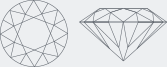
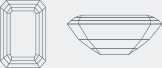
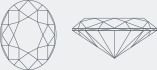
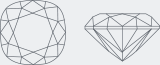
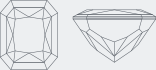
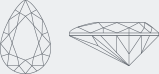
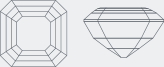
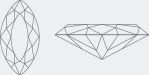
Diamonds are cut into lots of different shapes. Round brilliant cut diamonds are the most popular, followed by princess cut, oval, emerald cut, cushion, Asscher cut, pear shape, Marquise, Radiant, heart shape, trilliant and baguette.
There is a shape to suit everybody’s tastes, why not try mixing different shape diamonds to achieve something bespoke to you.
Round Brilliant Cut
The modern round brilliant has set the standard for all other diamond shapes, and accounts for more than 75% of diamonds sold today. It has 57 facets (polished faces), counting 33 on the crown (the top half), and 24 on the pavilion (the lower half). The girdle is the thin middle part. The function of the crown is to diffuse light into various colours and the pavilion’s function to reflect light back through the top of the diamond. The facets maximize the volume of light that is reflected from the inside and produce the greatest brilliance. Other round diamond shapes include the Eight Cut or Single Cut, Old Cut, Swiss Cut, Rose Cut.
Princess Cut
A relatively new shape which is usually square but sometimes oblong. The term ‘Princess’ is really a slang term used loosely to describe a square shaped stone. The proper name is a ‘square modified brilliant cut’ when used to describe a square diamond. It has a brilliant cut arrangement of facets instead of a step cut, which is usually found in square cut diamonds like the Emerald style. The Princess produces a much more brilliant diamond than a traditional step cut square or oblong and has some of the sparkle of a Round brilliant cut.
Emerald Cut
A rectangular or square shaped cut with truncated corners and stepped facets, typically parallel to the girdle. The emerald cut diamond reflects less light than the standard brilliant cuts and needs to be of the highest quality as any inclusions can be visible.
Oval Cut
Most oval diamonds are like a squashed round brilliant – a modification of the round brilliant cut. Aspect ratio of an Oval cut: The ratio of the length to the width should be about 1.5:1. Their depth to diameter ratio varies so they can never be a perfect proportion which results in a loss of some brilliance.
Cushion Cut
A four sided deep square or rectangle cut with rounded edges and large facets – it has a cushioned shaped girdle. The cut is usually multi-faceted to give the highest possible light refraction and is therefore especially suited for candlelight.
Radiant Cut
This square or rectangular cut combines the elegance of the emerald shape diamond with the brilliance of the round, and its 70 facets maximize the effect of its colour refraction. Because of its design, this cut requires more weight to be directed toward the diamond’s depth in order to maximize brilliance.
Pear Cut
The Pear Shaped Diamond is a fiery cut with lots of wonderful sparkle and flash. A hybrid cut, combining the best of the oval and the marquise, it is shaped most like a sparkling teardrop. The pear shaped diamond is also called the “teardrop diamond” because of its shape.
Asscher Cut
The Asscher Cut was developed by Joseph Asscher, who was commissioned by the Royal Family to cut the world’s largest diamond in history; the 3,106ct Cullinan diamond, after which he invented the now-famous Asscher cut. This cut reached its peak of popularity in the 1920’s in very limited production. In 2001, the cut went through considerable research and development and was re-launched with new specifications and additional facets for a more brilliant shine. Because Asscher cuts have been revitalized, especially with the increasing popularity of square shapes, Princess and Asscher cuts are in demand more than ever.
Up until 2001, the Asscher cut was a hard to come by commodity and available mostly in antique shops or from art deco jewellery dealers, here at Victoria James we love and are fascinated by the Asscher cut and try to complement them with art deco designs.
It is a square, step cut shape with cropped corners. An almost octagonal outline enhances the brilliance of the stone.
Marquise Cut
An elongated shape with pointed ends inspired by the fetching smile of the Marquise de Pompadour and commissioned by the Sun King, France’s Louis XIV, who wanted a diamond to match it. The Marquise shape is like a long oval which has been stretched out to a point at each end. They are most often seen as centre diamonds for engagement rings and wedding rings to balance the long, narrow shape.
Trilliant Cut
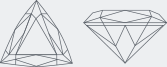
First developed in Amsterdam, the exact design can vary depending on a particular diamond’s natural characteristics and the cutter’s personal preferences. It may be a traditional triangular shape with pointed corners or a more rounded triangular shape with 25 facets on the crown, 19 facets on the pavilion, and a polished girdle. It is definitely for the adventurous.
Baguette Cut
The long, rectangular baguette-cut diamond has octagonal corners. Baguette-cut diamond jewellery earned popularity in the 1920s and 1930s during the art deco and art nouveau movements, which emphasized geometric form with straight, clean lines.
Although emerald-cut diamonds have more facets than baguette-cut diamonds, both stones offer a look and style that is different from the fiery princess and round cuts.
Heart Cut
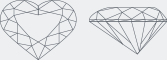
Essentially a pear-shaped diamond with a cleft at the top containing 59 facets. The shape of the heart makes this diamond highly desirable for romantic occasions such as Valentine’s Day and anniversaries.
The Four C’s
Diamond colour
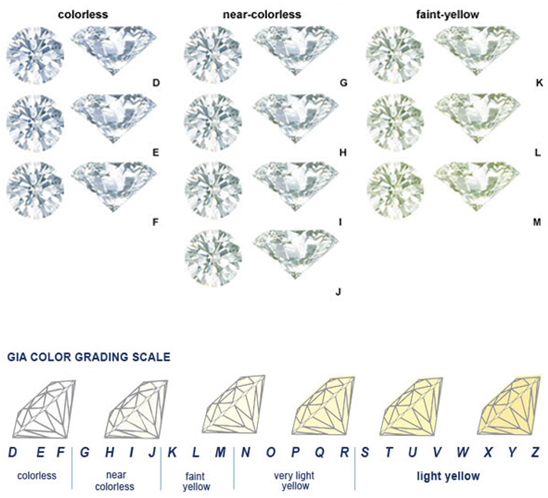
The Gemological Institute of America(GIA)is the most respected and most common diamond report and sets the industry standard for colour and clarity grading.
The finest quality diamond is a colourless diamond which is graded as “D” which means it is absolutely free from any colour.
The next is very slight traces of colour which can be observed by any expert diamond valuer or grading laboratory. These are graded as E colour or F colour diamonds. Diamonds which show very little traces of colour are graded as G or H colour diamonds.
Slightly coloured diamonds are graded as I or J or K colour and so on.
Diamonds can be found in other colours, some coloured diamonds such as naturally occurring pink and blue diamonds can be very rare and very expensive or even priceless.
There are also coloured diamonds that are enhanced or ‘coloured’, resulting in generally much deeper, more primary colour compared to the pastel colours found in a naturally occurring coloured diamond.
The most common and most popular enhanced coloured diamond is a black diamond.
At Victoria James, we aim to provide you with the highest quality diamond possible, but we appreciate that budget may also enter into the equation, so we can, if you wish, guide you to achieve the perfect balance.
Diamond Clarity
Clarity is a measure of internal defects of a diamond called inclusions. Inclusions may be crystals of a foreign material or another diamond crystal, or structural imperfections such as tiny cracks that can appear whitish or cloudy. The number, size, colour, relative location, orientation, and visibility of inclusions can all affect the relative clarity of a diamond.
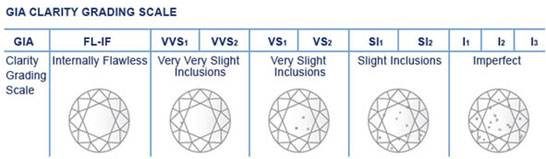
The Gemological Institute of America (GIA) developed systems to grade clarity, which are based on those inclusions which are visible to a trained professional when a diamond is viewed under 10x magnification. The Clarity of your diamond is graded using this scale:
Polish and symmetry are two important aspects of the cut. The polish describes the smoothness of the diamond’s facets, With poor polish, the surface of a facet can be dulled, and may create blurred or dulled sparkle. It may constantly look like it needs to be cleaned. The symmetry refers to alignment of the facets, with poor symmetry, light can be misdirected as it enters and exits the diamond. It is the Cut and symmetry of your diamond that determines how light is bounced from facet to facet, resulting in the wonderful sparkle diamonds are so loved for.
The techniques for cutting diamonds have been developed over hundreds of years, with perhaps the greatest achievements made in 1919 by mathematician and gem enthusiast Marcel Tolkowsky. He developed the round brilliant cut by calculating the ideal shape to return and scatter light when a diamond is viewed from above. The modern round brilliant has 57 facets (polished faces), counting 33 on the crown (the top half), and 24 on the pavilion (the lower half). The girdle is the thin middle part. The function of the crown is to diffuse light into various colors and the pavilion’s function to reflect light back through the top of the diamond.
Flawless category (FL)
Diamonds have no inclusions or blemishes visible under 10x magnification. Internally Flawless category (IF) Diamonds have no inclusions visible under 10x magnification, only small blemishes on the diamond surface.
Very, Very Slightly Included category (VVS)
Diamonds have minute inclusions that are difficult for a skilled grader to see under 10x magnification. The VVS category is divided into two grades; VVS1 denotes a higher clarity grade than VVS2. Pinpoints and needles set the grade at VVS.
Very Slightly Included category (VS)
Diamonds have minor inclusions that are difficult to somewhat easy for a trained grader to see when viewed under 10x magnification. The VS category is divided into two grades; VS1 denotes a higher clarity grade than VS2. Typically the inclusions in VS diamonds are invisible without magnification, however infrequently some VS2 inclusions may still be visible to the eye. An example would be on a large emerald cut diamond which has a small inclusion under the corner of the table.
Slightly Included category (SI)
Diamonds have noticeable inclusions that are easy to very easy for a trained grader to see when viewed under 10x magnification. The SI category is divided into two grades; SI1 denotes a higher clarity grade than SI2. These may or may not be noticeable to the naked eye.
Included category (I)
Diamonds have obvious inclusions that are clearly visible to a trained grader under 10x magnification. Included diamonds have inclusions that are usually visible without magnification or have inclusions that threaten the durability of the stone. The Included category is divided into three grades: I1. denotes a higher clarity grade than I2, which in turn is higher than I3. Inclusions in I1 diamonds are often seen to the unaided eye. I2 inclusions are easily seen, while I3 diamonds have large and extremely easy to see inclusions that typically impact the brilliance of the diamond, as well as having inclusions that are often likely to threaten the structure of the diamond.)
This category is also known as ‘piquet’ (P1, P2, P3) which is French for ‘mark’ or ‘blemish’.
Diamond cut
Diamonds are renowned for their ability to transmit light and sparkle so intensely. We often think of a diamond’s cut as shape (round, emerald, pear) but a diamond’s cut grade is really about the symmetry, proportioning and polish of a diamond andhow well a diamond’s facets interact with light.This means if it is cut poorly, it will be less luminous.
The cut of a diamond greatly affects a diamond’s brilliance and iscrucial to the stone’s final beauty and value.
Of all the diamond 4Cs, it is the most complex and technically difficult to analyze.
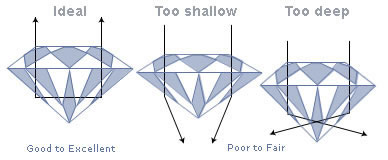
The cut is mainly influenced by the harmony between the table and depth percentages and crown and pavilion angels, either causing the diamond to dissipate light (poor cut) or optimally refract and reflect light (excellent cut).
In simple terms – If a diamond is cut either too shallow or too deep then the light cannot refract correctly and does not sparkle as much.
The GIA grades a diamonds cut using the scale; Excellent, very good, good, fair, poor.
Hearts and arrows
During the 1980s in Japan, it was discovered that when a round brilliant diamond with exceptional symmetry was viewed from the bottom through a special viewer a pattern of hearts could be seen, and when viewed from the top showed eight gray arrowheads. Diamonds displaying such exceptional symmetry account for less than 1 % of all diamonds cut. The highest grades of polish, symmetry and perfect cutting angles allow it to reflect more light than a standard cut diamond.
Diamond carat
Diamond carat (weight)
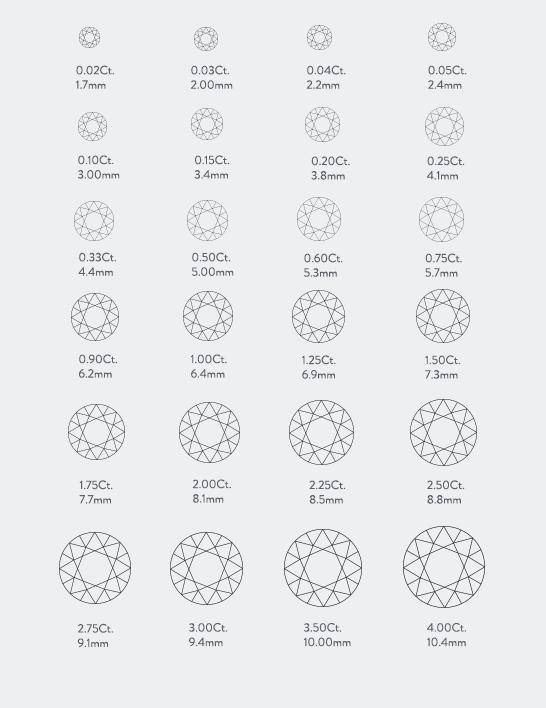
The size of your diamond is measured in Carat weight. You can use the table opposite as an approximate guide to what sizes different carat weights are in millimetres.From 0.20cts upwards we can help find the perfect balance between size, quality and price.
Diamond Carat Origin
The meaning of the word carat comes from Mediterranean region, where civilization has its roots, carob trees have flourished there since ancient times. It is against the seeds of these trees that diamonds were once weighed. One carob seed equals one modern carat – the word we use today to describe the weight of diamonds.
In the Far East, diamonds were weighed against grains of rice, and the term grainer was coined. Today, in many of the world’s diamond districts, dealers still quantify the weight of diamonds in grainers. A four-grainer diamond equals one diamond carat. Since 1913, diamonds have been weighed against the metric system.
1 carat (ct.) = .2 grams = .007 ounces
Diamonds are weighed to three decimal points and then rounded to the nearest hundredth. Diamonds under one carat are usually described in points. The price per carat increases with carat weight, since larger diamonds are both rarer and more desirable for use as gemstones.
Diamond polish
This website uses cookies to improve your experience. If you continue to use this site, you agree with our Privacy Policy